
What to Do During a Car Breakdown: A Step-by-Step Guide
Table of Contents
Immediate Actions When Your Car Breaks Down Assess the situation and your safety Activate your hazard lights
Assess the situation and your safety
Activate your hazard lights
How to Safely Pull Over and Position Your Vehicle Maintaining momentum and steering control Finding the safest shoulder location
Maintaining momentum and steering control
Finding the safest shoulder location
Exiting Your Vehicle Safely and Staying Visible When to stay in your vehicle Using reflective triangles and safety vests
When to stay in your vehicle
Using reflective triangles and safety vests
Car Emergency Kit Checklist: What You Need Essential items for any breakdown Items specific to your vehicle type
Essential items for any breakdown
Items specific to your vehicle type
How to Signal for Help on the Highway Calling roadside assistance and emergency services Providing your location with GPS coordinates and mile markers
Calling roadside assistance and emergency services
Providing your location with GPS coordinates and mile markers
What to Do If Your Car Breaks Down at Night Increasing visibility in low-light conditions Managing panic and staying calm
Increasing visibility in low-light conditions
Managing panic and staying calm
Highway vs. Local Road Breakdowns: Key Differences Traffic flow and blind spot awareness Guardrail safety and breakdown lane positioning
Traffic flow and blind spot awareness
Guardrail safety and breakdown lane positioning
After Your Breakdown: Documentation and Next Steps Recording details for insurance and warranty claims When to seek professional vehicle maintenance
Recording details for insurance and warranty claims
When to seek professional vehicle maintenance
Last Updated: August 6, 2026
Immediate Actions When Your Car Breaks Down
When your car breaks down, the first 60 seconds determine your safety. Recognize what's happening, stay calm, and take immediate protective action.
Assess the situation and your safety
The moment you notice something wrong, loss of power, strange noises, warning lights, or loss of steering control, understand what you're dealing with quickly without obsessing over diagnosis. Get to safety first.
Check your immediate surroundings. Are you on a highway with fast-moving traffic or a local road? Approaching an intersection or guardrail? Your location determines your next move. Take three seconds to breathe. Most car breakdowns are manageable if you follow a clear sequence.
Activate your hazard lights
The moment your car breaks down, activate your hazard lights immediately. Find the hazard light button, usually a triangular symbol on your dashboard or steering column, and press it. Your lights should flash on all four corners of the vehicle. Hazard lights tell other drivers that your vehicle is disabled and moving slowly or stopped. Without them, you're invisible to traffic flow, and that's when accidents happen.
How to Safely Pull Over and Position Your Vehicle
Maintaining momentum and steering control
If your engine is still running and you have steering control, you have time to move. Assess what you still have: Can you steer? Can you brake? These answers determine your next action.
If you have steering and some braking ability, use momentum to coast toward the safest available location. Don't jam on the brakes unless you're in immediate danger. Gradual deceleration gives you more control and signals to drivers behind you that something is wrong. If your brakes are failing, shift into a lower gear to use engine resistance to slow down.
On a highway, your goal is to reach the shoulder as quickly as possible without losing control. Use your turn signal if you can; it tells other drivers what you're doing.
Finding the safest shoulder location
Not all shoulders are created equal. Avoid stopping near curves, hills, or areas with poor visibility. Look for flat ground away from guardrails, trees, or other obstacles. Distance from the roadway is always better than a barrier.
If you're approaching an exit, keep coasting toward it. A well-lit parking area or gas station is infinitely safer than the shoulder of a busy road. Your vehicle's momentum is your asset right now, use it.

Exiting Your Vehicle Safely and Staying Visible
When to stay in your vehicle
If you're on a highway or a road with significant traffic, stay inside your vehicle with the doors locked and seatbelt fastened until you've assessed the traffic pattern. A moving vehicle hitting a stationary one is far more dangerous than staying inside. Your car provides protection; standing on the shoulder does not.
Wait for a gap in traffic. When you see a safe window, ideally a full minute with no approaching traffic, then exit. Open your door carefully, checking your blind spot first. Step out onto the shoulder side, away from traffic. Never step into the breakdown lane or toward oncoming traffic.
If you're on a quiet local road or in a parking area, exit immediately and move away from the vehicle.
Using reflective triangles and safety vests
Your car emergency kit should contain reflective warning triangles and a safety vest. Put on your safety vest before you exit the vehicle. A bright orange or yellow vest makes you obvious to approaching drivers, even at night.
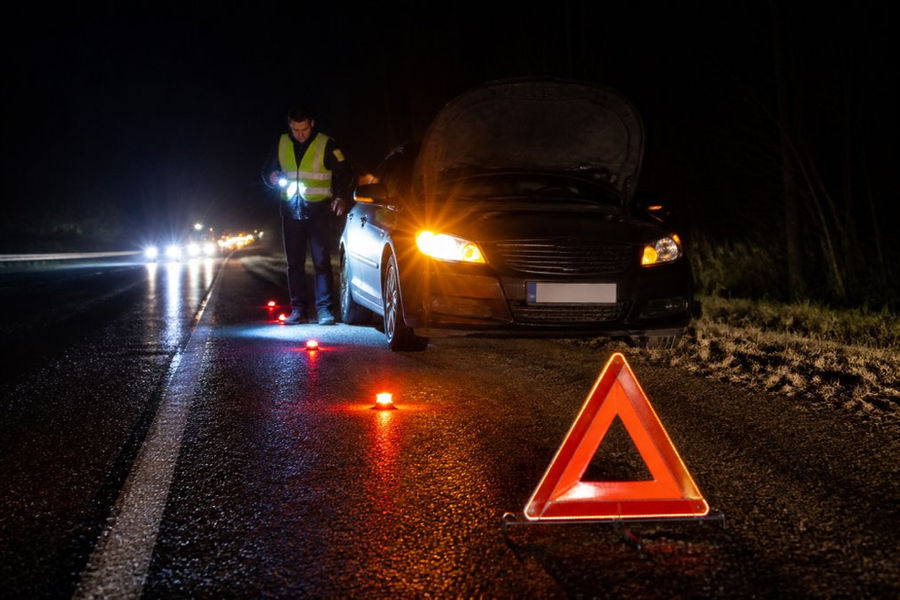
Place reflective triangles on the road behind your vehicle at 10-15 feet, then another set at 25-30 feet. This creates a visual buffer that warns approaching drivers to slow down and change lanes. On a highway, space them wider, up to 50 feet apart. The triangles catch headlights and reflect them back, creating a warning beacon.
Car Emergency Kit Checklist: What You Need
Essential items for any breakdown
Every vehicle should carry an emergency kit. Start with the basics: a flashlight with extra batteries, a multi-tool or knife, jumper cables, a basic tool kit (screwdrivers, pliers, adjustable wrench), and duct tape. Add a spare tire (check that it's properly inflated), a tire jack, and a lug wrench.
Next, add safety items: reflective warning triangles, a safety vest, flares, and a first-aid kit. Include a phone charger and a portable power bank. Add water bottles, a blanket, and a flashlight. Include documentation: a copy of your insurance card, your vehicle's registration, and contact information for roadside assistance. Write down your vehicle identification number (VIN) and keep it separate.
Item | Purpose | Priority |
Jumper cables | Dead battery recovery | High |
Spare tire + jack | Flat tire repair | High |
Flashlight + batteries | Visibility and diagnosis | High |
Reflective triangles | Road hazard warning | High |
Safety vest | Personal visibility | High |
First-aid kit | Injury treatment | High |
Multi-tool | General repairs | Medium |
Duct tape | Temporary fixes | Medium |
Phone charger | Communication | High |
Water + blanket | Survival basics | Medium |
Items specific to your vehicle type
Your vehicle type determines what else you need. For EVs, jumper cables are useless. Instead, focus on a portable EV charger or a power bank that can charge your vehicle's onboard systems. Add extra water and a blanket, since you can't run the heater if the battery is dead.
For vehicles with manual transmissions, add extra motor oil and transmission fluid. Check your owner's manual for vehicle-specific fluids and capacities. If you live in a cold climate, add tire chains, sand or kitty litter for traction, and extra blankets. If you live in a hot climate, add extra water and a sunshade.
How to Signal for Help on the Highway
Calling roadside assistance and emergency services
Before you break down, know who to call. Save your roadside assistance number in your phone right now. When you call, have this information ready: your location (mile marker, GPS coordinates, or nearby exit), your vehicle description (make, model, color, license plate), and a description of the problem.
If you're in immediate danger, call 911 first, then call roadside assistance. Emergency services can block traffic and protect you. Stay on the phone with the dispatcher. They'll keep you calm and give you instructions while you wait.
Providing your location with GPS coordinates and mile markers
Location is everything. Use GPS coordinates if you have them; your phone's maps app can provide exact latitude and longitude. If you're on a highway, mile markers are your best friend. Look for a green sign showing a number (mile marker 42, for example). This tells the dispatcher exactly where you are.
If you're on a local road, provide street names and nearby landmarks. Write down your location before you call. If your phone dies, you need this information written down or memorized.
What to Do If Your Car Breaks Down at Night
Increasing visibility in low-light conditions
Nighttime breakdowns are more dangerous because visibility drops dramatically. Turn on your headlights and hazard lights immediately. Use your high beams if they're working; the extra light makes you more visible to approaching traffic.
Activate your interior dome light if you're staying in the vehicle. This makes the car visible from a distance and signals that someone is inside. If you exit the vehicle, use a flashlight to illuminate yourself. Point the light toward approaching traffic so drivers see you.
Deploy flares in addition to reflective triangles. Flares burn and create visible light that's impossible to miss, even on a dark night. Place them at 10-15 feet behind your vehicle, then 25-30 feet. The combination of flares and triangles creates a visible warning zone.
Managing panic and staying calm
Panic is your enemy at night. Remind yourself that your situation hasn't changed, it's just darker. The same safety principles apply. You're still in a vehicle that provides protection. Help is still on the way.
Stay in your vehicle if you're on a busy road. Lock the doors. Run the engine periodically to keep warm, but crack a window to avoid carbon monoxide buildup. If your vehicle has a panic button or emergency alert system, use it.
Use your phone's flashlight app to stay oriented. If you're alone and feeling unsafe, call 911 and stay on the line. You're not overreacting by calling, you're being smart.
Highway vs. Local Road Breakdowns: Key Differences
Traffic flow and blind spot awareness
A breakdown on a highway is fundamentally different from one on a local road. Highway traffic moves faster, travels in tighter clusters, and gives drivers less time to react. On a highway, other drivers are traveling 55+ mph and often don't notice disabled vehicles until the last second.
On a local road, traffic moves slower and is more dispersed. Drivers are more alert. You have more time to react and more options for positioning your vehicle.
Position yourself on the shoulder away from the traffic lane. Don't stand between your vehicle and the roadway, that puts you in the blind spot of approaching drivers. Stand ahead of your vehicle or behind it, but not beside it.
Guardrail safety and breakdown lane positioning
On highways with guardrails, position your vehicle as far from the guardrail as the shoulder allows. If you must stop near a guardrail, exit on the side away from the guardrail. Never stand between your vehicle and the guardrail.
The breakdown lane (also called the shoulder) is your staging area. Don't pull into the breakdown lane and stop immediately; coast as far as possible to maximize distance from traffic. The farther you are from the traffic stream, the safer you are.
On a multi-lane highway, use the rightmost lane to exit. Crossing multiple lanes increases your risk. If you're in the left lane when your car breaks down, signal and move right gradually, using momentum to coast across lanes.
After Your Breakdown: Documentation and Next Steps
Recording details for insurance and warranty claims
Once you're safe and help is on the way, document everything. Take photos of your vehicle's position, the surrounding area, and any visible damage. Note the time, date, location, and weather conditions.
Write down the tow truck driver's name and company. Get a tow receipt with the pickup location, time, and destination. If you have extended warranty coverage, notify your warranty provider immediately. Document any expenses: towing costs, hotel if you're stranded overnight, rental car, meals. Keep receipts for everything.
Take photos of your vehicle's odometer, maintenance records, and any warning lights or gauges that were active before the breakdown. This creates a timeline and supports your claim if you need to pursue warranty coverage.
When to seek professional vehicle maintenance
After a breakdown, your vehicle needs a professional inspection before you drive it again. A qualified technician will diagnose the root cause, not just the symptom.
Cruiser Auto Repair provides comprehensive mechanical services and can handle both routine diagnostics and complex repairs. Whether your breakdown was minor or major, a professional inspection gives you clarity on what happened and what needs to be fixed. Our team handles extended warranty repairs directly with providers, so if your vehicle is covered, we manage the claim process for you, no back-and-forth with the warranty company.
Don't drive a vehicle with unknown mechanical issues. A professional inspection costs far less than a second breakdown or an accident caused by mechanical failure.
A car breakdown is stressful, but it's manageable if you follow a clear sequence: assess, signal, position, stay visible, and call for help. Keep an emergency kit in your vehicle, know who to call before you break down, and stay calm. When you need professional help afterward, Cruiser Auto Repair is here to diagnose the problem, handle your warranty claim, and get your vehicle back on the road safely. Schedule your appointment with us and let our professionally qualified technicians take the stress out of vehicle repairs.
Frequently Asked Questions
What should you turn on your vehicle if you are broken down?
Activate your hazard lights immediately when your car breaks down. Hazard lights alert oncoming traffic that your vehicle is disabled and stationary. If you're on a highway at night, also turn on your headlights to increase visibility. If you exit your vehicle, use flares or reflective triangles to create additional warning markers. These steps ensure other drivers see you and adjust their speed or change lanes to avoid your vehicle.
Is it safer to stay in the car or get out during a breakdown?
Stay inside your vehicle if you're on a busy highway or in heavy traffic. Exiting puts you at risk from oncoming vehicles and blind spots. However, if your vehicle is in a dangerous position or you smell smoke or fuel, exit immediately and move to a safe distance away from traffic. On local roads with lighter traffic, you may safely exit to retrieve your emergency kit or set up warning triangles. Always prioritize your safety over vehicle protection.
What items should be in a car emergency kit checklist?
A complete car emergency kit should include jumper cables, a flashlight with extra batteries, a first aid kit, reflective triangles or flares, a safety vest, basic tools (wrench, screwdriver, pliers), a jack, spare tire, tire repair kit, blanket, water, non-perishable snacks, phone charger, and a multi-tool. Include any items specific to your vehicle, such as extra coolant or power steering fluid. Store your kit in an easily accessible location in your trunk and check it twice yearly to replace expired items.
How do I provide my location when calling for roadside assistance?
If you have cellular service, call your roadside assistance provider or emergency services and provide your GPS coordinates if available through your phone. If GPS isn't accessible, note the mile marker closest to you on highways, or describe nearby landmarks, street names, and intersection details on local roads. Include your vehicle color, make, model, and license plate number. Stay on the line with the dispatcher until help arrives, and avoid wandering away from your vehicle where you can't be easily located.
SCHEDULE YOUR APPOINTMENT
This article was written using GrandRanker


Comments