
How to Fix Tire Pressure Monitoring System Light
Table of Contents
Start Here: What Your Tire Pressure Monitoring System Light Is Telling You
Steady Light vs. Flashing Light
How to Check Tire Pressure with a Gauge (Do This First)
Finding Your Recommended Tire Pressure
Inflate, Deflate, and Verify: Correcting the Pressure
Why Your Tire Pressure Light Stays On After Filling Tires
TPMS Light Flashing? Here's What It Means
Steady, Flashing, and Flashing-Then-Steady: A Diagnostic Flow
What to Do While the Light Is Flashing
Signs That Point to a Sensor, Not Air
Sensor Replacement and What to Expect
The TPMS Relearn Procedure: Resetting Your System
The Four Reset Methods You Will Encounter
Where Is the Reset Button?
After a Rotation, Always Relearn
When the Light Returns After a Reset
When to Stop Resetting and See a Professional
Frequently Asked Questions
Last Updated: October 19, 2026
Start Here: What Your Tire Pressure Monitoring System Light Is Telling You
A tire pressure monitoring system tracks the air pressure in each tire and warns you when one drops below a safe level. Since 2008, federal rules have required this system on new passenger vehicles sold in the United States. At Cruiser Auto Repair, we see drivers panic over this light every week, and most of the time the fix is simpler than they fear.
The light is not a suggestion: a tire low on air changes how your car steers, brakes, and grips the road.
Steady Light vs. Flashing Light
Steady light: One or more tires has low pressure. Check and adjust the air.
Flashing light: The system itself has a fault, usually a sensor issue. The pressure may be fine.
Flashing then steady: A sensor fault plus low pressure. Handle the pressure first.
Pro Tip If the light flashes for about a minute when you start the car and then stays on, the system is running a self-test and finding a sensor it cannot read. That is your cue to book a sensor check, not to keep adding air.
How to Check Tire Pressure with a Gauge (Do This First)
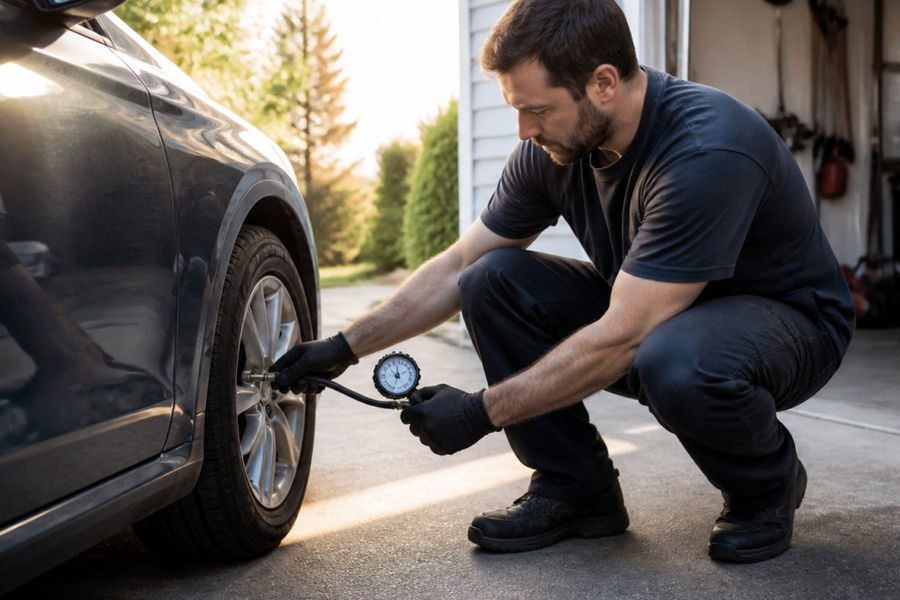
Checking tire pressure with a gauge takes about five minutes and costs nothing at most gas stations. Start with cold tires, the car has sat at least three hours or you have driven less than a mile. Heat from driving raises pressure and gives a false high reading.
Here is the sequence we recommend:
Unscrew the valve cap on the first tire and keep it somewhere safe.
Press the gauge firmly onto the valve stem for a second or two.
Read the number and write it down.
Repeat for all four tires, and check the spare if your car has one.
Compare each reading to the recommended pressure.
Finding Your Recommended Tire Pressure
The correct pressure is printed on a sticker in the driver's door jamb, sometimes called the vehicle placard, and in the owner's manual. Use the car maker's number, not the number molded into the tire sidewall, that figure is the tire's maximum, not what your car needs.
Most passenger cars land between 30 and 36 PSI, but check your own placard.
Inflate, Deflate, and Verify: Correcting the Pressure
Add air with a compressor at a gas station or in your garage, then recheck with your gauge. Fill in short bursts and check between each one, because it is easy to overshoot. If you go too high, press the small metal pin in the valve center to let air out until you hit the target.
ChrisFix
A common mistake is trusting the gauge on the air machine, those built-in gauges drift. Believe your own handheld gauge.
Watch Out Overinflating to "be safe" is a real hazard. A tire pumped well past its rating wears unevenly in the center and grips the road with less of its tread. Set it to the placard number and leave it there.
Why Your Tire Pressure Light Stays On After Filling Tires
The tire pressure light stays on after filling tires because most systems need a short drive to recheck and clear. Some cars update within a mile; others need a reset command. If the light is still on after ten minutes of driving with correct pressures, move to the reset step.
There is a second reason worth knowing. A slow leak can drop a tire again within days. If the same tire keeps going low, you likely have a puncture or a bad valve stem, and no amount of resetting will fix it.
TPMS Light Flashing? Here's What It Means
A flashing TPMS light means the system has lost contact with one or more sensors, and the pressure itself may be fine. It is the most misunderstood warning on the dash, and where most drivers waste money adding air to tires that are already correct.
Steady, Flashing, and Flashing-Then-Steady: A Diagnostic Flow
The light's behavior is a diagnostic code before you plug in a scan tool:
Steady light. One or more tires is below the threshold. Check pressure with a gauge, cold, against the door-jamb placard. Fix the air first.
Flashing light (often 60-90 seconds at startup, then solid). The system is running its self-test and cannot read a sensor. The pressure is likely correct, so chase the sensor, not the pressure.
Flashing then steady. A sensor fault plus low pressure can coexist. Handle the pressure first, because a genuinely low tire is the immediate safety issue, then address the sensor.
Light that comes on only in cold weather and clears as you drive. This is usually a pressure threshold issue from temperature drop, not a sensor fault. Recheck cold and top off.
What to Do While the Light Is Flashing
A flashing TPMS light is not an emergency in itself, but it means you have lost a safety monitor on at least one wheel. Pull over at the next safe opportunity and check pressure with a gauge. If any tire is visibly low, soft, or damaged, do not continue at highway speed, inflate it or call for roadside assistance. If all tires hold pressure and the light still flashes, you can drive to a shop for a scan, but treat the vehicle as having no tire-pressure warning until repaired.
Watch Out Do not ignore a flashing light for weeks. A sensor that has failed is also a sensor that cannot warn you about a real puncture. You are driving without the safety feature you paid for.
Signs That Point to a Sensor, Not Air
Light flashes at startup, then stays solid
One tire always reads low on the dash even after filling
The dash reading does not match your gauge
The light returns within days of a correct reset
A sensor was recently replaced or a tire recently rotated
Any of these points to a sensor or a relearn problem, not air. A diagnostic scan tool reads the fault codes and identifies which wheel is not reporting.
Sensor Replacement and What to Expect
TPMS sensors run on small batteries sealed inside the sensor. When the battery dies, the whole sensor is replaced, there is no battery swap.
A shop will scan the system, confirm which sensor failed, replace it, and relearn it to the vehicle. Expect the sensor plus labor and the relearn step; many shops quote the job as a package.
If your vehicle is under an extended warranty or a tire-and-wheel service contract, sensor replacement is often covered. Ask the shop to confirm coverage before work begins so you are not surprised at the counter.
The TPMS Relearn Procedure: Resetting Your System
The TPMS relearn procedure teaches the car which sensor sits at which wheel. Run it after a rotation, a sensor swap, or a stubborn light. Exact steps depend on your vehicle, so treat the methods below as a map, not a script. The owner's manual is the final authority, if it and this guide disagree, follow the manual.
Key Takeaway Always fix the pressure first, then reset. Resetting a system with a genuinely low tire just hides the warning until it comes back.
The Four Reset Methods You Will Encounter
Most vehicles use one of four approaches. Knowing which one you have saves you from hunting for a button that does not exist.
1. Automatic relearn (drive cycle). Common on newer vehicles.
2. Dashboard menu reset. Many vehicles with a driver-information display let you scroll to a tire-pressure menu and confirm a reset with the steering-wheel controls, the most common method on late-model cars.
3. Reset button. Older vehicles and some trucks use a physical button. Look on the lower dash near the steering column, inside the glovebox, or under a small cover in the center console.
**4.
Where Is the Reset Button?
If your car has one, it is almost always in one of four places: the lower dash left of the steering column, the glovebox, the center console under a small cover, or the overhead console. If you cannot find one after checking those spots, your car likely uses the menu or drive-cycle method. Do not pry at the dash, check the manual first.
After a Rotation, Always Relearn
Skipping the relearn after a tire rotation is why so many drivers see a light days later with perfectly good pressure. The sensors still report, but the car now thinks the front-left sensor is at the rear-right position, so the dash readings look wrong even though every tire is correct. Run the relearn procedure the manual specifies and the readings line up again.
When the Light Returns After a Reset
A light that comes back within a few days of a successful reset is telling you something the reset cannot fix. Work through this escalation instead of resetting again:
Same tire keeps going low. A slow leak, a nail, a bad valve stem, or a corroded wheel bead. Have the tire inspected and repaired; resetting will not seal a puncture.
Light returns with all pressures correct. A sensor is failing or its battery is dying. The system is losing contact with that wheel.
Light returns after a temperature drop. Pressure falls roughly 1 PSI for every 10°F drop in ambient temperature. A tire set at 33 PSI on a warm day can read low after a cold snap. Recheck cold and top off; this is normal, not a fault.
Light returns after a sensor replacement. The new sensor was not relearned to the vehicle. The shop needs to complete the relearn step.
Spare tire involved. Some systems monitor the spare. If your vehicle does, a low spare can trigger the light even when all four road tires are correct. Check the spare per the manual.
If you have corrected pressure, completed the correct relearn, and the light still returns, stop resetting. A repeated reset on a real fault only delays the repair and keeps a safety warning dark.
When to Stop Resetting and See a Professional
Stop resetting and get a professional inspection when the light returns within a few days, when a sensor will not respond, or when a flashing pattern will not clear.
A shop can scan the system, confirm which sensor failed, and replace and relearn it. If you want to see what a visit looks like, you can schedule your appointment and we will take it from there.
One last habit worth building: check your tire pressure once a month and before long trips. It is the cheapest way to keep this light off your dash for good.
A tire pressure warning light can turn a normal morning into a stressful one, but the fix usually comes down to a gauge, an air hose, and the right reset.
Frequently Asked Questions
How do I reset my tire pressure sensor light?
First, check and correct all tire pressures to the vehicle's recommended PSI, found on the door-jamb placard. Then, with the key on and engine off, press and hold the TPMS reset button until the light blinks three times. Some vehicles require a drive cycle of 10-20 minutes above 20 mph for the system to relearn. If the light stays on, a sensor may need professional service.
Can I drive with the tire pressure light on?
A steady light means pressure is low, so drive cautiously to the nearest air station and inflate. A flashing light for 60-90 seconds indicates a system fault, not low pressure, and the system may not warn you of future issues. In either case, avoid high speeds and long trips until you've checked pressures and addressed the warning.
How long does it take for the TPMS light to turn off after inflating tires?
After inflating to the correct pressure, the light typically turns off within a few minutes of driving, as the sensors update. Some vehicles need a 10-20 minute drive cycle above 20 mph. If it stays on after that, recheck pressures with a gauge, inspect for leaks, or have the system scanned for a sensor fault.
Why is my TPMS light flashing instead of staying steady?
A flashing TPMS light signals a system malfunction, such as a dead sensor battery, a sensor that isn't communicating, or a fault in the module. It usually flashes for about a minute after startup, then stays on. Correct tire pressure won't fix this; a diagnostic scan tool is needed to identify which sensor or component has failed.
SCHEDULE YOUR APPOINTMENT

Comments